
How Long Does It Take to Cross Stitch? Real Estimates
How many stitches an hour can you do? Realistic cross stitch time estimates for small, medium and large patterns, plus tips to stitch faster.
In this post
“How long will this take me?” is the question I ask before every new project, and the one I hear most when someone wants to stitch a gift. So how long does it take to cross stitch something? Honestly, it depends on how many stitches the pattern has and how fast you stitch. The good news is that both are easy to measure.
The quick answer: most new stitchers make roughly 30 to 60 full cross stitches an hour, and comfortable stitchers often manage around 100. So a 1,000-stitch ornament takes about 10 to 20 hours, a 5,000-stitch piece 50 to 100 hours, and a 20,000-stitch sampler several hundred. Divide the stitch count by your own speed to get your number.
If you’re brand new, my complete beginner guide to cross stitch covers the basics first. This post is all about time.
How long does it take to cross stitch? Stitches per hour
There’s no official speed. Stitchers who time themselves report anything from about 30 to well over 100 full stitches an hour, and the same person can be twice as fast on one chart as on another.
Here’s roughly what I see, and what you can use as a starting point:
| Where you are | Rough speed | What it feels like |
|---|---|---|
| First project | 30 to 60 stitches an hour | Lots of checking the chart, re-threading, counting twice |
| Comfortable | 80 to 120 stitches an hour | You know your method, the chart is clear, colors are in blocks |
| Fast and practiced | 150 or more | Long runs of one color, little backstitch, years of habit |
On a good night, with a big block of one color, I’m somewhere around 100 an hour. On a fiddly section with five colors in a small area, I’m much slower, and that’s fine.
A time table by pattern size
Most pattern listings tell you the size in stitches (for example 40 x 40). That’s the grid size, not the stitch count, because a lot of the grid is usually empty fabric. A 40 x 40 ornament has 1,600 squares but often only 900 to 1,200 actual stitches.
Some real examples from my own charts:
| Pattern | Grid size | Actual full stitches |
|---|---|---|
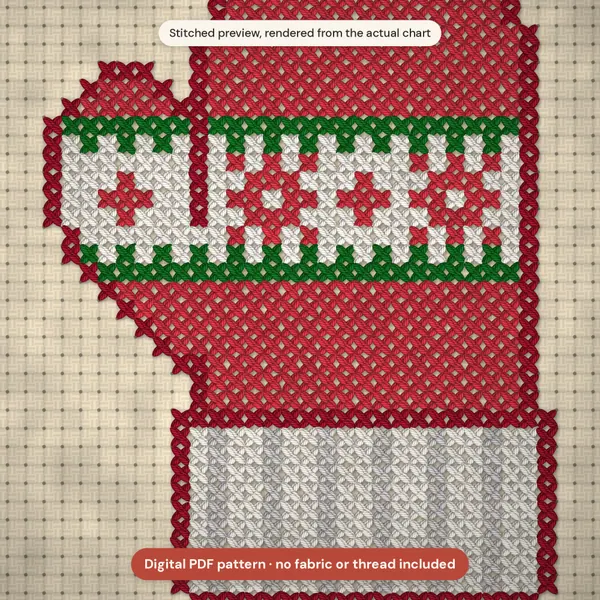
| Red Mitten ornament | 32 x 40 | about 800 |
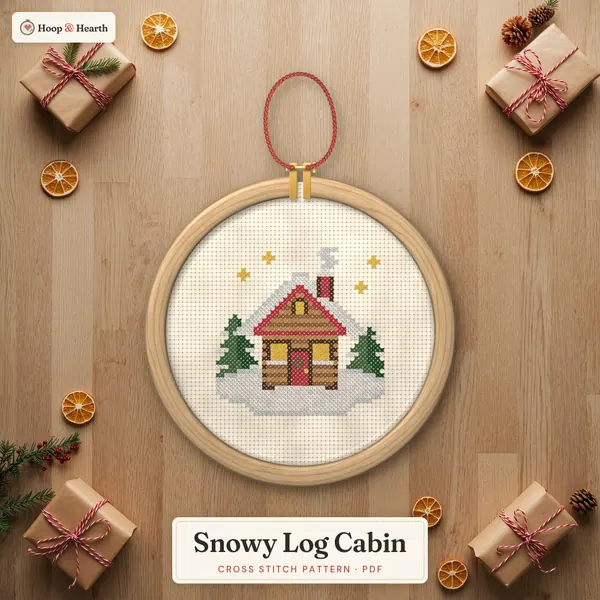
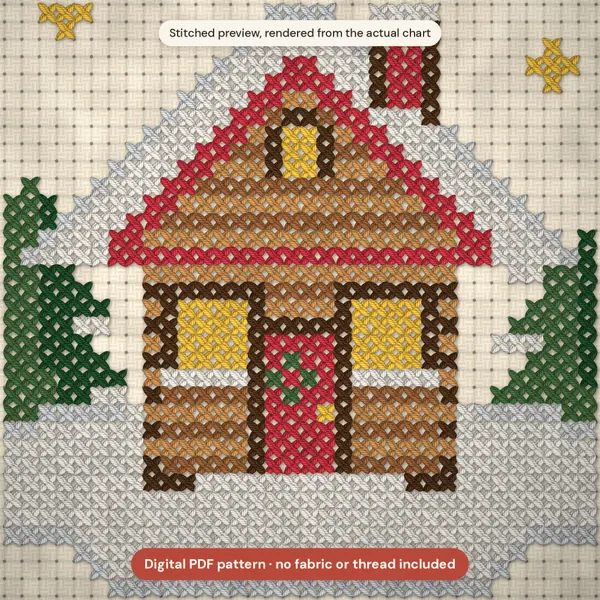
| Snowy Log Cabin ornament | 40 x 40 | about 980 |
| Cat in a Mug | 44 x 50 | about 1,150 |
| Toadstool Cottage | 60 x 72 | about 2,600 |
And here’s what those stitch counts turn into, at three speeds:
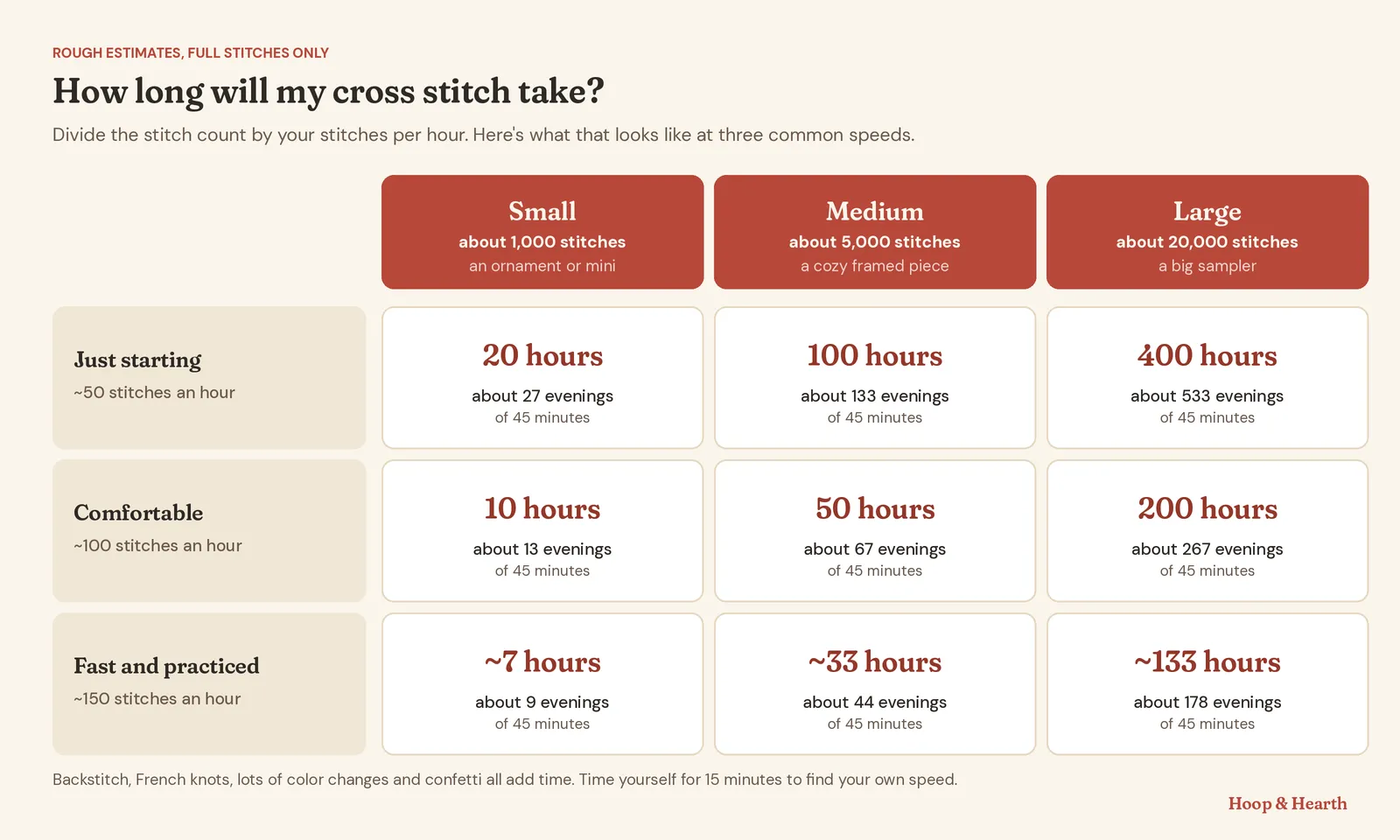
The evenings column is the one I find most useful. “Thirteen evenings” feels a lot more real than “ten hours”.
a little gift for you
Get your free cross stitch patterns
Join The Hearth Letter and download every freebie instantly, plus 15% off your first order and cozy stitching tips from Sara.
We send about two letters a month. Unsubscribe with one click.
What slows you down
Two patterns with the same stitch count can take very different amounts of time. These are the usual culprits:
- Confetti. Single stitches of a color scattered across the chart mean starting and ending a thread for one or two crosses. A confetti-heavy chart can easily take twice as long. I wrote a whole post on what confetti is and how to spot it.
- Number of colors. Every color change costs a minute or two. A 6-color design flows. A 40-color design stops and starts.
- Backstitch and French knots. They’re quick per stitch but slow per inch, and you often have to change to one strand. See backstitch and French knots for tips.
- Fabric count. Higher counts (16, 18, linen over one) mean smaller holes and more squinting. Same stitch count, more time. My fabric count guide explains the trade-off.
- Hard-to-read charts. Look-alike symbols and missing 10 x 10 grid lines make you count everything twice.
- Tired eyes and bad light. Real, and very common after bedtime.
How to estimate your own speed (a 15-minute test)
This takes one evening and gives you a number you can use forever.
- Pick a part of your current project with a decent block of one color.
- Set a timer for 15 minutes. Stitch normally, no racing.
- Count the full stitches you made.
- Multiply by 4. That’s your stitches per hour for easy sections.
- Do it once more on a busier part with several colors. That’s your “fiddly” speed.
Use something between the two for planning, and lean toward the slower number if the chart has lots of colors or confetti.
Planning a gift deadline (backwards calendar)
When I’m stitching for someone, I plan backwards from the day I need to hand it over.
- Pick the hand-over date. Say December 20.
- Take off finishing time. Washing, drying, pressing and turning it into an ornament or framing it: give yourself 3 to 4 days. That’s December 16.
- Add a buffer. Life happens, kids get colds. I add 20 percent to the stitching time.
- Work out the evenings. Stitch count ÷ your speed = hours. Hours ÷ how long you stitch per evening = evenings.
For example, the Red Mitten ornament has about 800 stitches. At 60 an hour that’s roughly 13 hours, or about 16 hours with the buffer. At 45 minutes a night, that’s around 21 evenings, so I’d want to start by about November 24.
If your date is closer than that, choose a smaller design. My post on last-minute cross stitch gifts has ideas that fit in a week or two, and how to make cross stitch ornaments covers quick finishing.
Ten ways to stitch a bit faster (without losing the joy)
None of these are about rushing. They just remove the little stops that add up.
- Stitch in rows when you have a block of color. Work a row of half stitches ( / / / ) and then come back across to finish the crosses ( \ \ \ ). This is often called the Danish method, and it’s quicker for big areas than completing each X one by one.
- Cut floss to a sensible length. About 18 inches (45 cm). Longer threads tangle and wear, shorter ones mean constant re-threading.
- Prepare your floss ahead. Wind each color onto a numbered bobbin before you start, or cut a few lengths of tomorrow’s colors before you put the hoop away.
- Use the loop start when you’re stitching with 2 strands. It’s fast and leaves nothing to tidy later. Here’s how to start without a knot.
- Keep tension even with a hoop or frame that holds the fabric snug. Some people stitch faster “in hand”, others with a frame. Try both.
- Get good light. A daylight lamp over your shoulder is the single best speed upgrade I’ve ever made.
- Grid your fabric with a removable gridding thread or a water-soluble pen so you rarely miscount. Unpicking is the slowest stitching of all. More on that in how to fix cross stitch mistakes.
- Mark off as you go, on paper with a highlighter or in an app. If you use a tablet, my Pattern Keeper guide shows how.
- Park your threads in confetti-heavy areas instead of starting and ending each one.
- Choose kind patterns. Fewer colors, bigger blocks, clear symbols. It’s the reason I design the way I do.
Why I stopped racing my stitching
Speed is useful for planning. It’s not the point. A small finish in ten slow evenings still feels wonderful to hang on the tree.
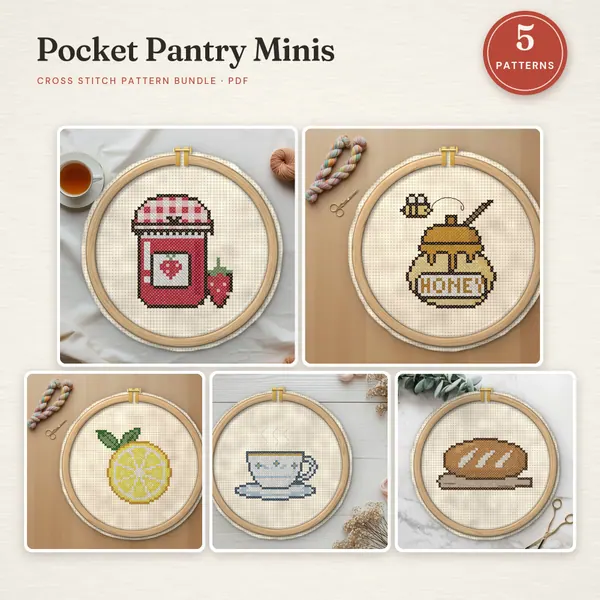
If you’d like to keep an eye on your projects without the pressure, a simple stitching planner or the free WIP tracker helps you see your progress over a month. And when you’re ready for something small and satisfying, the Pocket Pantry Minis and Cozy Christmas Ornaments are all small enough to finish in a few weeks of evenings, not months. You can check any finished size in the fabric size calculator.
For everything else about getting started, head back to the beginner’s guide to cross stitch.
a little gift for you
Start with a small, quick pattern
Join The Hearth Letter and get my free beginner pattern and cheat sheet straight away.
We send about two letters a month. Unsubscribe with one click.
Frequently asked questions
How many cross stitches can you do in an hour?
It varies a lot. New stitchers often manage around 30 to 60 full stitches an hour, while comfortable stitchers working big blocks of one color can do 100 or more. Lots of color changes, confetti and backstitch slow everyone down. A 15-minute timed test is the best way to find your own number.
How long does it take to cross stitch a bookmark?
A typical bookmark design of around 25 to 30 stitches wide and 90 to 100 tall has somewhere between 1,500 and 2,500 stitches once you leave out the background. At 60 to 100 stitches an hour that is roughly 15 to 40 hours, plus an evening for finishing.
How long does it take to cross stitch a Christmas stocking?
Full-size stocking charts are big, often several thousand to well over 10,000 stitches, so they can take anywhere from 50 to a couple of hundred hours. If you want one for this Christmas, start early or choose a small stocking ornament instead.
How long does it take to learn to cross stitch?
You can learn the basic stitch in one evening. Most people feel comfortable reading a chart, starting and ending threads, and keeping the back tidy after their first small project or two.
Patterns to try
Stitch along with this post
Keep reading
More from the blog
Cross Stitch Glossary: WIP, FFO, SAL, Frogging & More
What do WIP, FO, FFO, SAL, HAED, PK, frogging and confetti mean? A friendly A-Z cross stitch glossary of terms and abbreviations for new stitchers.
How to Fix Cross Stitch Mistakes (Frogging Made Easy)
Miscounted? Wrong color? How to unpick cross stitch safely, fix tension and messy backs, and stop thread tangling, without damaging your fabric.
How Many Strands for Cross Stitch? A Simple Chart
How many strands of floss to use on 11, 14, 16 and 18 count aida or evenweave: a simple chart, how to separate floss, and when to break the rules.